Sunday, August 30, 2020

Reflections on Take up the Cross


The Dutch priest, theologian and psychologist,  Henri Nouwen  1932-1996 wrote a meditation on Taking up the Cross as he reflects that in life we all have pain to deal with:

“Your pain is deep, and it won’t just go away. It is also uniquely yours, because it is linked to some of your earliest life experiences.

Your call is to bring that pain home. As long as your wounded part remains foreign to your adult self, your pain will injure you as well as others. Yes, you have to incorporate your pain into your self and let it bear fruit in your heart and the hearts of others.

This is what Jesus means when he asks you to take up your cross. He encourages you to recognize and embrace your unique suffering and to trust that your way to salvation lies therein. Taking up your cross means, first of all, befriending your wounds and letting them reveal to you your own truth.

There is great pain and suffering in the world. But the pain hardest to bear is your own. Once you have taken up that cross, you will be able to see clearly the crosses that others have to bear, and you will be able to reveal to them their own ways to joy, peace, and freedom.


Definition of the Cross

…..the cross performs a function of synthesis and measurement.  In it Heaven and Earth are conjoined…in it time and space are intermingled.  The cross is the unbroken umbilical cord of the cosmos, linking it to the center from which it sprang.  Of all symbols the cross is the most universal and all-embracing.  It symbolizes intervention, mediation, the natural and permanent structure of the universe and communication between Heaven and Earth and Earth and Heaven.


-Champeaux,G.de and Dom Sterckx, S. (O.S.B.) Introduction au monde des symboles, Jean Chevalier and Alain Gheerbrant, Dictionary of Symbols


Prayer

O God of love,

We journey with your son,

ever closer to Jerusalem,

to his cross, his true destiny.


We hear his words

“Take up your cross and follow me,”

but we’re not sure what this may mean for us.


We hear his words,

“deny your self,”

and wonder which self it is;

the self we put on for others,

or the self centred self

that wants it all for ourselves?


Whichever it is,

it seems like Jesus

is asking for all of us

and we’re not sure we can do this.


God, we will need your Holy Spirit

to be able to do this.

God, we will need your grace and mercy

to be able to do this.


We remember that you empowered your disciples,

the early Christians,

and others who decided to follow you and

we know and trust that you will do this for us.

Amen.


Friday, August 28, 2020

Sandcastles


Geoff writes:

Castles are meant to be all about permanence, durability, strength. But for most of us, our first encounter with a castle was the exact opposite – building a sandcastle on a childhood holiday!


Sandcastles didn’t last long, as many a child’s tears have testified. If the feet of fellow holidaymakers or seaside donkeys didn’t bring down our carefully crafted towers and battlements, the tide would do the job.


I suspect there is something of King Cnut in every child. I loved to pile up ramparts of sand in the face of the advancing waves, to watch the first stream of water flood into the moat and flow back, repulsed by my handiwork.


But of course the smallest child soon learns that it is only a matter of time, no matter how fervently he or she shovels fresh sand onto the crumbling walls, before the rising water floods in and a hasty retreat must be made through the cold water, back to the family picnic blanket.


To everything there is a season ……a time to build up, a time to break down.

(Ecclesiastes 3 v5 – Pete Seeger’s paraphrase from the words of ‘Turn! Turn! Turn!’)


In the Bible God reminds us time after time that human endeavours are not meant to last forever.


But that does not make them meaningless. We are each granted our time in the sunshine, to do what we can for as long as we can – and to trust that, when the time comes, we can still retreat with dignity. Our God will be waiting for us with a big, warm dry beach towel.


Wednesday, August 26, 2020

Castles of Dreams


Geoff writes: 

When young Prince Ludwig of Bavaria looked out from his bedroom window in his father’s ‘country’ palace on the edge of the Alps, he saw the ruins of an ancient castle on a steep pinnacle of rock. And he dreamed………


The castle he built at Neuschwanstein has probably graced the front page of more tourist brochures than any other.  Few realise that it was built in the 1870s.


Irrational, fantastic, but a stunning testament to romantic ideals of beauty and chivalry, it was a cry of protest against the industrialised Realpolitik of Kaiser Wilhelm’s new Germany.


Of course, it helps if you’re a Prince or a King.  Ludwig was wise enough to know that the realities of life in the middle ages were very different from the ideals, but he followed his dream.


Despite his popularity among ordinary Bavarians, his extravagance and eccentricity were too much for the Establishment. He was deposed in a family coup d’etat and died in mysterious circumstances. But his memory is revered in modern Bavaria – if only as the unintentional founding father of Bavaria’s flourishing tourist industry.


God has a soft spot for dreamers, even if their dreams appear controversial or divisive at first. Remember Joseph, whose bizarre dreams also drove his brothers to the brink of fratricide. He didn’t have the wealth of a prince, but with the guidance and protection of God he delivered his dream and saved his family, and the whole of Egypt, from starvation.

Monday, August 24, 2020

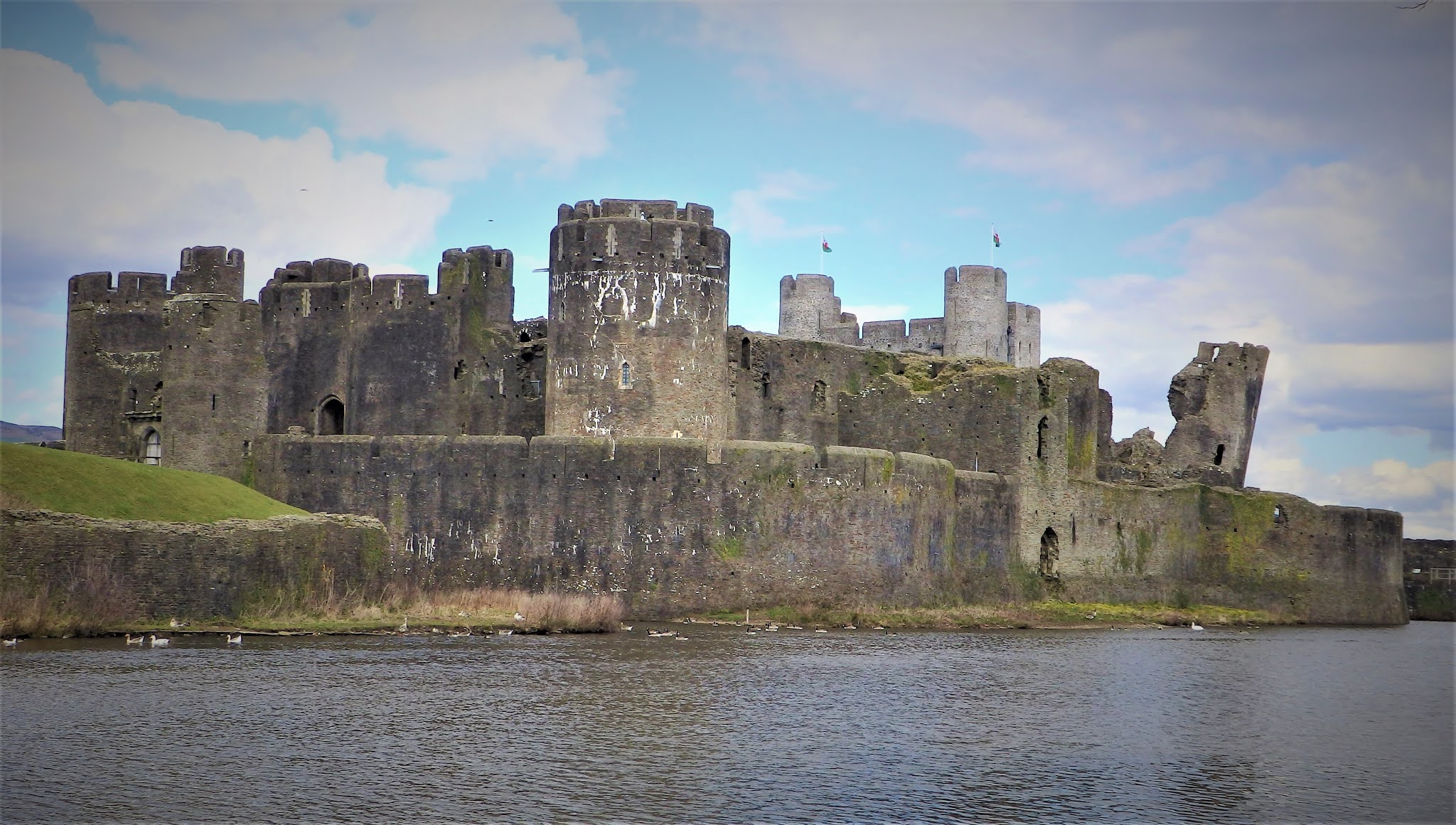
Ruins


Caerphilly (Gwent/Glamorgan)

 Geoff writes: 

Our turbulent national history (notably the the long-disputed borders between England and Wales and England and Scotland) have left us with a remarkable legacy of ruined castles. These were the ones that did not find a new use in the post-mediaeval economy and were fortuitously too remote to be plundered for building materials.


The existence of our stone castles is really a testament to the violence, insecurity and injustice that dominates so much of our history. They tell of strength, but also of disunity and fear; of a squabbling military aristocracy that relied on stone walls and weaponry to keep their rivals, and their peasant populations, often newly conquered, under control.


At the end of the Civil War, when the old castles played a role in armed conflict for the last time, Cromwell’s Parliamentarians blew holes in their walls and put them permanently out of service. The ordinary population didn’t miss them at all.


Anyone who knows the story of the Fall of Jericho (Joshua 6) will know that the God of Israel also had little respect for stone fortifications.


But he has to remind the Kings and rulers of Judah and Israel again and again, through the words of Amos, Micah, Isaiah and Jeremiah, that they too should not put their trust in stone battlements. Instead they should gain the favour of God by obedience to his commandments of justice.


They didn’t listen. The walls of Jerusalem could not save the city when Nebuchadnezzar of Babylon broke them down in 586 BC. The walls lay in ruins for 140 years.


Saturday, August 22, 2020


These months of lockdown and distancing have brought most of us many sorrows and difficulties and we continue to hope and pray that we are now beginning to emerge from the worst of the effects of the pandemic. Alas, many other countries are even now facing the full brunt of the virus and we are warned of the possibility of a second spike. Cautionary news at best.

Keeping strong in faith is always important, especially during difficult times, and while nothing can take away our ability to pray and trust we have been deprived of our customary fellowship and mutual support. Thankfully we now have the opportunity to worship together in our church on Sunday mornings, albeit in somewhat reduced circumstances; it does feel odd to share communion with masks, visors, distancing and sanitizing. And some of us need to protect ourselves in a manner that means we cannot safely return to church yet, however it has been inspiring to see a large number of our church members coming to share in worship, plus others joining in with the video services.


Some of our hymns refer to the difficulties we can face, and they urge us onwards. For example, “Through the night of doubt and sorrow, onward goes the pilgrim band” which in ordinary times seems a bit miserable perhaps, takes on a life of its own. It affirms “one the light of God’s own presence o’er his ransomed people shed; chasing far the gloom and terror, brightening all the path they tread”.  Likewise, “Thy hand O God hath guided thy flock from age to age” refers to hard times “when shadows thick were falling….” and challenges us today:  “And we, shall we be faithless, shall hearts fail, hands hang down?” leading to the glorious affirmation “Thy presence will not fail us nor leave thy work undone: with thy right hand to help us, the victory shall be won”. Yes!


And if you want something more contemporary, there’s “Lord, the light of your love is shining, in the midst of the darkness shining”, with a prayer for ourselves and for our nation “Shine, Jesus, shine, fill this land with the Father’s glory; blaze, Spirit, blaze, set our hearts on fire”. In the hardest times we call upon God afresh for our own commitment to be renewed and for the good of our nation and our world.

O Lord Jesus Christ, Lord of hope and glory, keep us calm and faithful in all troubles.

Give strength and direction to all who seek to do your will – to all who strive for peace, all who work for righteousness, all who exercise the ministry of caring and healing.

Renew our faith to meet these troubled times, that your peaceful, holy and saving presence may uphold us day by day. Amen.


Tuesday, August 18, 2020

A wander through some holiday snaps


 Geoff Oates write about Castles: 

After beaches, the great staple of the English holiday outing is…the castle. Since childhood I have spent countless happy hours exploring every tower, every battlement, every spiral staircase and every dungeon I could get into from Dover to Dunstanburgh and from the Rhine to the Alps.


From ancient times the best castles stood on hilltops, as you see in the picture of Bamburgh on the Northumberland coast. It stands as testament to the colour and romance of the Middle Ages, and speaks of strength, confidence and security. They offered shelter and protection to people and livestock.


One of the most common and powerful images for God in our Old Testament scriptures is ‘Rock’.  Psalm 62: The LORD is my rock, and my fortress, and my deliverer’ I could have mentioned Psalm 18, Proverbs 18, 2 Samuel 22….and many more. The image is not of a mere pile of stone, but of a fortified hilltop. ‘Strong tower’ is another common image.


David, the warrior King, chose the rock of Zion, the highest of the hills that now make up Jerusalem, as his stronghold.


A Rock is not just of shelter and security in times of turmoil, but a vantage point, a watchtower from where we have a clearer, broader vision of all that surrounds us.


Even when we feel life is hemming us in, besieging us with trials, God our Rock gives us safety, and hope and perspective for the future.

Sunday, August 16, 2020

Miscommunication


In today’s Gospel there is an interesting and confusing exchange that goes on between Jesus and the Canaanite woman. She was an outsider.

In the account of this story we don’t understand everything about the situation. Many people spend a lot of effort and time trying to explain away Jesus’ response in these verses, yet as they remain, people interpret them differently.


Anyone who has written enough emails, or text messages knows the danger of miscommunication. Many times, what is received and understood is rather different than what was intended. Sometimes we interpret harshness or even malice where none was meant. Yet when this happens we rarely see ourselves in the wrong!


Here a person with a desperate family problem is begging Jesus for help and his response could have easily been interpreted as scorn or hate. She chose to look past that for the saving power and healing that she needed.

How many of us have felt harmed by someone? How many times we have heard some word or phrase and felt offended and felt our pride hurt?

In an age when there is so much offence given and taken, we need to ensure that we  should really know God’s desire for us: we can overcome our human feelings that drive us away from God and from each other even when we may have arguments in the church.

When we feel upset we can keep our focus on what is truly important, the saving power of Jesus, the love of God that overcomes all sadness and calls us all beloved children of God and gives us life in all its fullness.


Colossians 3:12-14

Therefore, as God’s chosen people, holy and dearly loved, clothe yourselves with compassion, kindness, humility, gentleness and patience. Bear with each other and forgive one another if any of you has a grievance against someone. Forgive as the Lord forgave you. And over all these virtues put on love, which binds them all together in perfect unity.